Beth Drops a Bouncy Ball Which Bounces Up Again
Bouncing balls
Summary of chore
Students were asked to pattern an investigation that determines the relationship betwixt the drib height of a brawl and its bounce back pinnacle. This chore was part of a pedagogy and learning unit on transformation of energy where students explored how energy comes in a variety of forms, including kinetic, gravitational potential and chemical potential energy. During this unit, students also inquired into how transformations between different forms of energy are rarely 100 per cent efficient, as part of the initial free energy is often converted into unintended forms of energy, such equally estrus or sound.
In this investigation, students were asked to decide the percentage of the drop height to which a brawl returns on billowy and whether that percentage varies for big or pocket-size drop heights. Students were made aware of the fact that the efficiency of the energy transformation depends on the fabric the ball is made of and that the bounce percent is an indicator of this efficiency. They were asked to compare the efficiencies of assurance fabricated from a variety of dissimilar materials.
Students were asked to submit their results in a written report (750 words maximum) in electronic form. They were asked to display the data for each type of brawl in graphical course and use the slope of the line of all-time fit to determine the energy efficiency of each ball. They were further asked to discuss what happens to the energy within the arrangement during a ball's drop-and-bounce bicycle and to calculate the maximum velocity of each brawl on impact with the floor when dropped from a peak of one metre.
Achievement standard
By the end of Yr 10, students analyse how the periodic tabular array organises elements and use it to make predictions almost the properties of elements. They explain how chemic reactions are used to produce detail products and how dissimilar factors influence the rate of reactions. They explicate the concept of energy conservation and represent free energy transfer and transformation within systems. They use relationships betwixt force, mass and acceleration to predict changes in the motility of objects. Students describe and analyse interactions and cycles inside and between Earth's spheres. They evaluate the show for scientific theories that explain the origin of the universe and the diversity of life on Earth. They explain the processes that underpin heredity and evolution. Students analyse how the models and theories they use have developed over time and discuss the factors that prompted their review.
Students develop questions and hypotheses and independently blueprint and improve advisable methods of investigation, including field work and laboratory experimentation. They explicate how they accept considered reliability, safety, fairness and ethical actions in their methods and identify where digital technologies can be used to raise the quality of data. When analysing information, selecting evidence and developing and justifying conclusions, they place alternative explanations for findings and explain any sources of dubiety. Students evaluate the validity and reliability of claims made in secondary sources with reference to currently held scientific views, the quality of the methodology and the show cited. They construct evidence-based arguments and select advisable representations and text types to communicate science ideas for specific purposes.
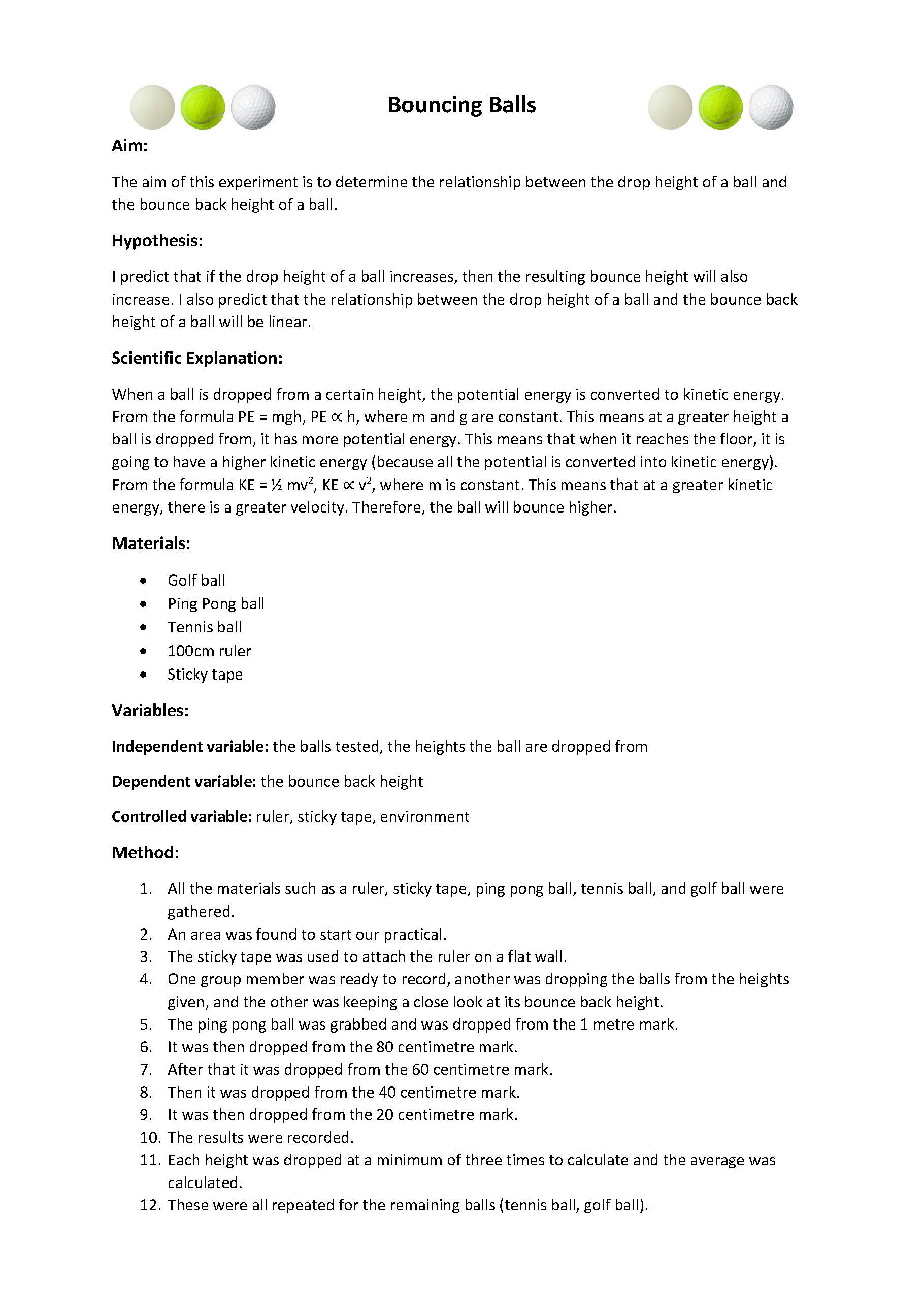 1 Note 1
Uses detailed scientific and mathematical reasoning to back up hypothesis 2 Annotation 2
Describes experimental method in form of a report
-
Annotations
- 1
Annotation 1
Uses detailed scientific and mathematical reasoning to support hypothesis - 2
Note 2
Describes experimental method in form of a report
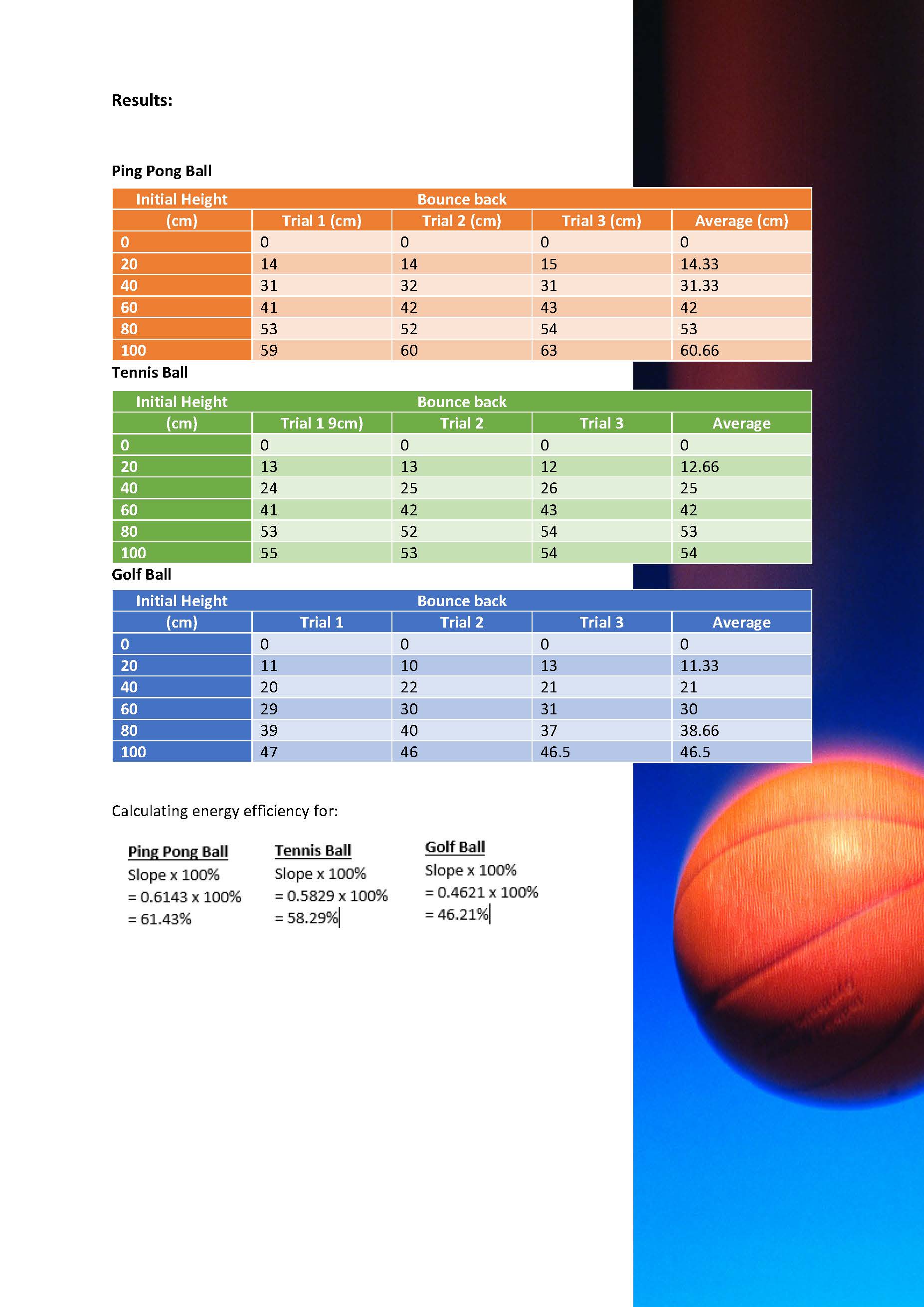 one Notation 1
Presents measured data in table 2 Note ii
Calculates energy efficiency from slope of line of best fit
-
Annotations
- 1
Notation 1
Presents measured data in table - ii
Annotation 2
Calculates energy efficiency from slope of line of best fit
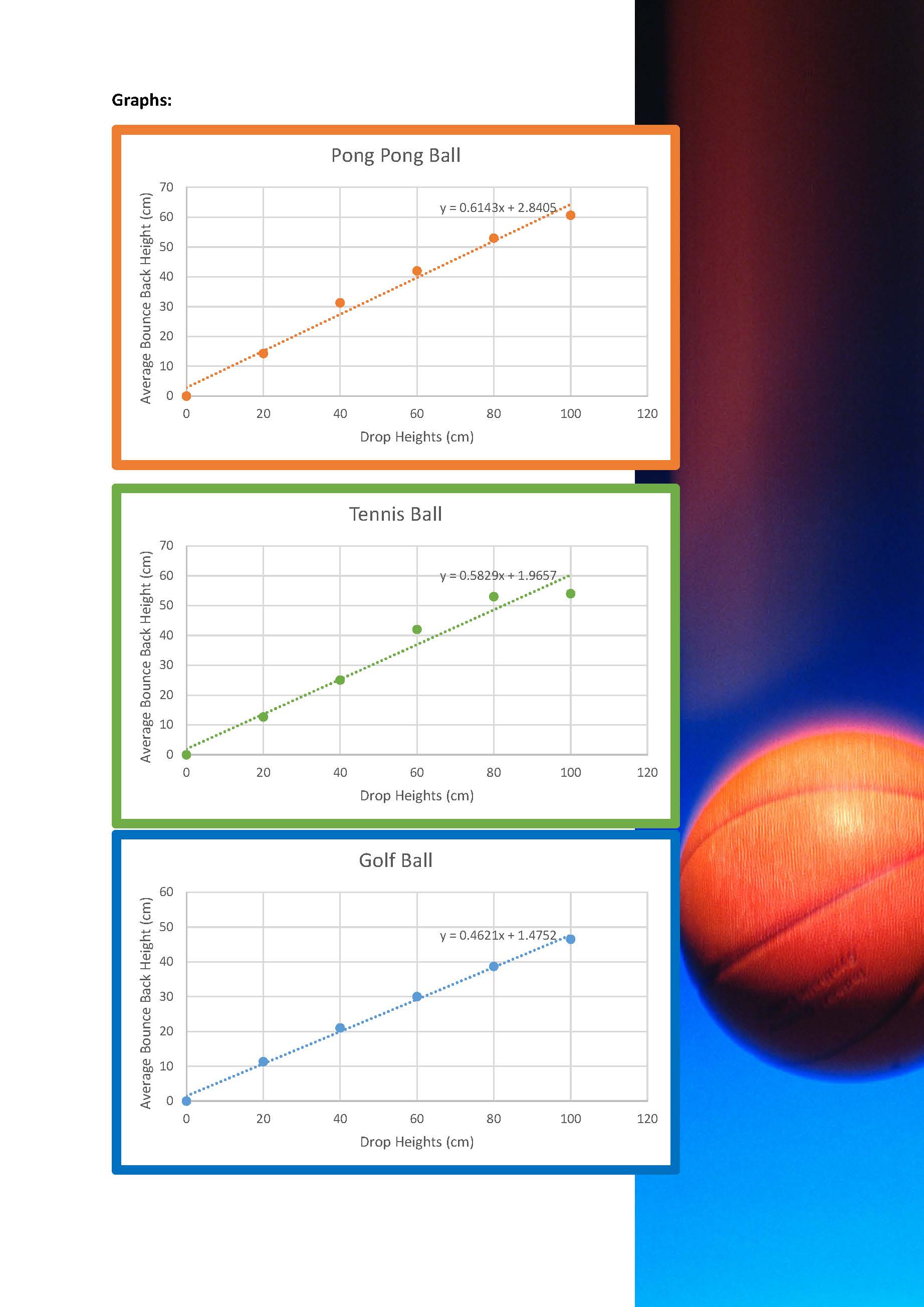 1 Annotation 1
Displays results in scatter plot, includes line of best fit ii Annotation 2
Displays line equation and quality of fit parameter
-
Annotations
- 1
Annotation 1
Displays results in scatter plot, includes line of best fit - two
Annotation 2
Displays line equation and quality of fit parameter
 1 Annotation one
Explains in detail energy transformations that occur during a brawl's drop and bounce cycle, implies that energy is conserved during the procedure two Notation 2
States mathematical equations for primary forms of energy involved, includes units of physical quantities and numerical values of constants iii Annotation three
Applies concept of energy conservation to make up one's mind the ball'south velocity at moment of maximum kinetic energy
-
Annotations
- 1
Annotation ane
Explains in item energy transformations that occur during a brawl'due south drop and bounce cycle, implies that free energy is conserved during the procedure - 2
Annotation 2
States mathematical equations for chief forms of energy involved, includes units of concrete quantities and numerical values of constants - three
Annotation 3
Applies concept of free energy conservation to determine the brawl's velocity at moment of maximum kinetic energy
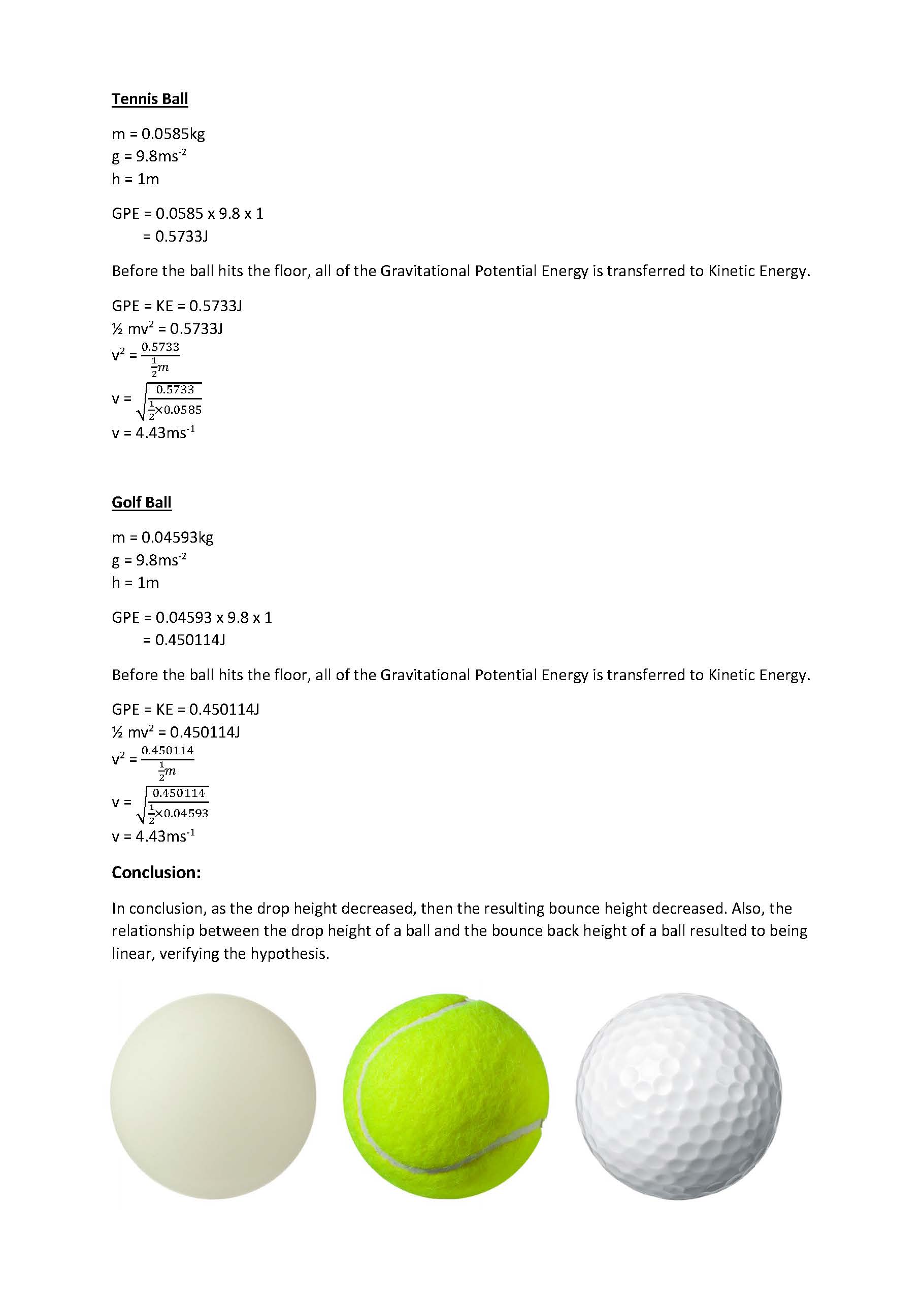 i Annotation 1
Draws conclusions that are consistent with experimental evidence
-
Annotations
- 1
Annotation 1
Draws conclusions that are consistent with experimental show
Similar samples
Related samples
blaylockworead1938.blogspot.com
Source: https://www.australiancurriculum.edu.au/resources/work-samples/samples/bouncing-balls-above/
0 Response to "Beth Drops a Bouncy Ball Which Bounces Up Again"
Post a Comment